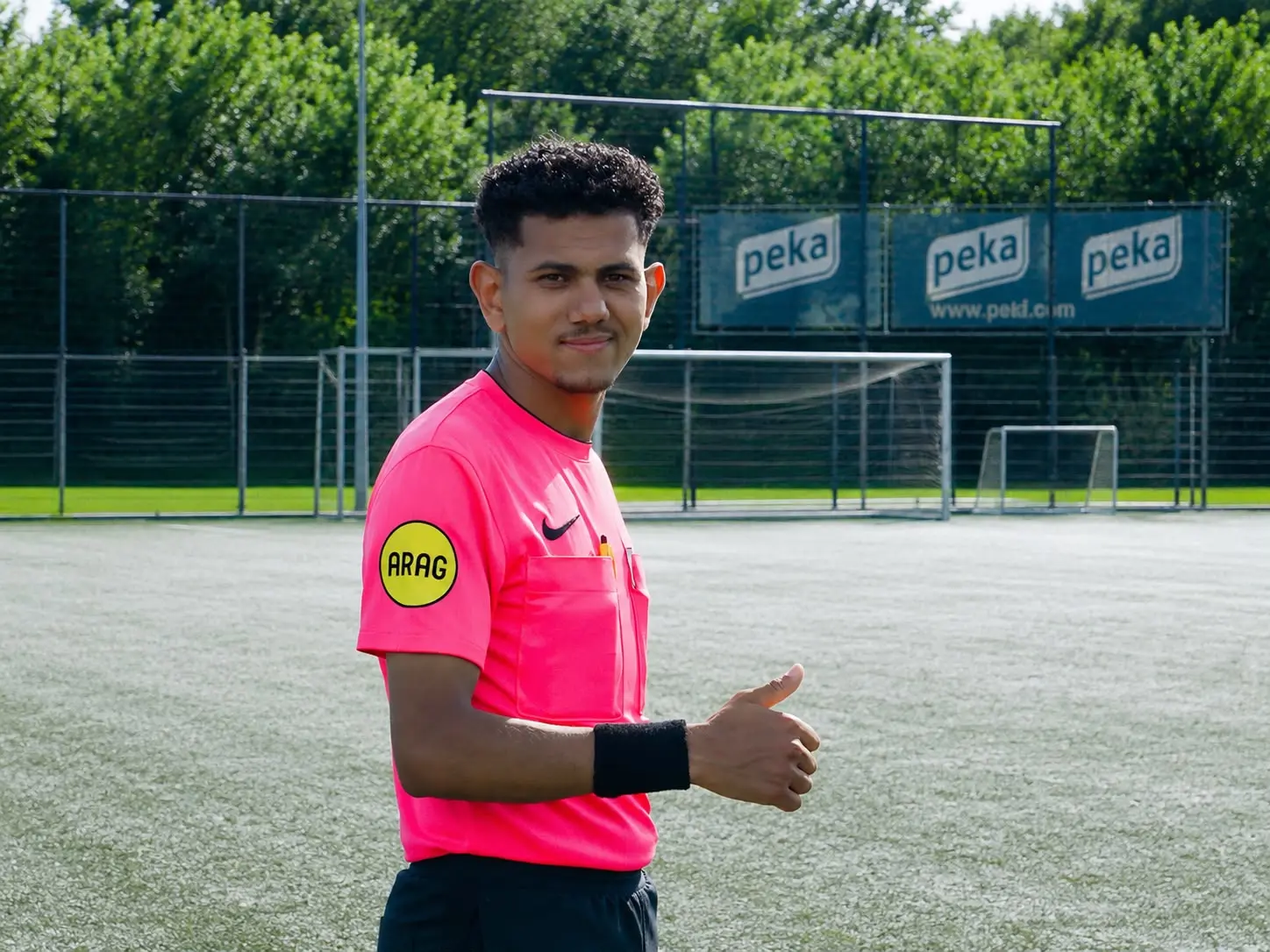
Mumin’s asylum application has been rejected, but he remains optimistic: 'The first thing I want to do is go to university'
Share on social media:
Mumin Tumeh (23) is a referee, works in a restaurant and wants to go back to university. But the IND is set to reject his asylum application. Whilst he has been waiting for months for the final decision, the Syrian Palestinian is trying to hold on to his plans for the future. Read his story here.
'I did not really have a normal childhood'
Mumin grew up in a Palestinian refugee family in Syria. As a child, he moved with his family several times. When he was 9 years old, they had to leave their home again because of the war. 'I did not really have a normal childhood,' Mumin says.
Football was a part of his life from an early age. Even before his family had to move again because of the war, Mumin played football with other boys from the neighbourhood. At first, he played as goalkeeper. He watched a lot of games and especially looked up to Iker Casillas, the former Real Madrid goalkeeper.
Until that point, Mumin had mainly seen his future as a goalkeeper. That changed when he saw the well-known Syrian referee Masoud Tufailiya officiating a game. Afterward, he approached him. 'I asked him, how does someone become a referee?' Not long after, Mumin gave up goalkeeping and began refereeing games himself. Before long, he was also refereeing adult games.
From referee to law student
Being a referee turned out to be important not only on the football field. Mumin realised that he found working with rules interesting: 'As a referee, you get used to rules. You learn the rules and apply them. That is why I thought: I am going to study law.'
For Mumin, those 2 worlds went hand in hand. On the football field, he had to know the rules and make decisions. He carried that interest with him into his law studies. Alongside his studies, he worked for a law firm for 2.5 years, assisting in court and with real estate matters.
The course Mumin could not attend
Mumin continued to make strides as a referee as well. In 2023, he and 13 other referees from a Syrian refereeing academy were selected to attend a course in Doha, Qatar. Mumin was the only Palestinian in the group.
When his travel documents were checked, a problem arose. Mumin did not have a Syrian passport, but rather a Syrian travel document for Palestinian refugees. As a result, he was ultimately unable to travel to Qatar. For Mumin, that was a pivotal moment. 'That was a kind of wake-up call for me,' he says. 'After that, I thought: I have no future here.'
'I said I was going to a match'
In addition to his plans for school and football, Mumin was also concerned about the possibility that he might have to serve in the military. He had to keep arranging for deferments. Without a valid deferment, he could be drafted.
Not long after the course in Qatar, Mumin decided to leave Syria. On his last day, he still went to work. At home, his family didn’t know that he would actually be leaving that evening. 'I told my mother I was going to a football game.'
That did not sound strange to his mum. Mumin spent almost every day playing football. He had wanted to have dinner with his family that evening, but that was no longer possible. He changed his clothes, took a shower, and left. It was not until he was already on his way that his family found out he had left Syria.
6 months on the road
The journey to the Netherlands took more than 6 months. Along the way, Mumin broke his leg and had to have surgery. He did not tell his parents at first, either. 'I only told my brother. I told him: do not tell my parents. They would just worry.'
It was not until 3 weeks after the surgery that he explained what had happened. It took several more weeks before he could walk well enough to continue his journey.
Mumin tried to enter Croatia from Bosnia. 'The Croatian police tried to send me and others back. People in my group were beaten, and my jacket and phone were stolen. In the end, I also had to provide my fingerprints in Croatia.'
Taking to the field with a borrowed whistle
Even after his arrival in the Netherlands, the uncertainty was not over. Because Mumin had to provide his fingerprints in Croatia, the Netherlands could, under European rules, send him back to Croatia. Mumin calls that period 'a nightmare'.
In the end, he did not have to go back. After that, football came back into the picture. 'I went with someone from the
Mumin explained that he was not a football player, but had been a referee in Syria for many years. 'The man immediately grabbed his phone and called someone at the club who was in charge of the referees. I was given the chance to referee a youth game. I did not even have a whistle. I asked if I could borrow one.'
After the match, Mumin showed his certificates, photos and footage of matches in Syria on his phone. The people at the club saw how much experience he already had. After that, he took matters into his own hands. He gathered documents from Syria and contacted the
The KNVB gave him a chance
The first game in which Mumin was supposed to be evaluated was cancelled. When he stepped onto the field, it was covered in ice. Mumin thought it was too dangerous to let the players play. 'I told both teams: I cannot let the players play here. They are my responsibility.'
Shortly afterward, he was assigned to another game, this time at the top division level for players under 17. A KNVB evaluator was standing on the sidelines.
The game went well. The evaluator gave Mumin a good rating. After that, according to Mumin, he did not need to be re-evaluated and was assigned an official KNVB game every Saturday. In about 3 months, he refereed 12 games. Later, he also refereed Under-19 games.
However, the future became uncertain again
While Mumin was working, learning Dutch, and refereeing football games, he received a letter on 20 April 2026, from the
Mumin is Palestinian and grew up in Syria. He does not hold Syrian citizenship. The IND believes he has not sufficiently demonstrated that he would be in personal danger if he returned to Syria.
Mumin recounts: 'As I was leaving Syria, I was held captive by an armed group for 10 days. I was questioned about who I was, where I came from and why I, as a Palestinian, had come to the area. I was mistreated there.'
Even before he left, Mumin noticed that his Palestinian background had an effect. On his way to university, he had to pass through several checkpoints. He was often stopped there and asked additional questions because he was Palestinian.
Mumin is now waiting for the final decision. He still keeps track of what is happening in the area where he used to live because the situation there is still unstable and unsafe. There are still a lot of weapons around. According to him, a hand grenade was even used during a fight in his neighbourhood. 'It is very hard for me to go back,' says Munim.
'The first thing I want to do is go to university.'
If Mumin were to hear that he is allowed to stay in the Netherlands, he knows what he would want to do first: 'The first thing I want to do is go to university. I feel like I have lost three years. My friends from university have already graduated.'