Deposit: why do you get money back for an empty bottle or can?
Share on social media:
When you buy a bottle of water or fizzy drink, or a can of fizzy drink or beer in the Netherlands, you often pay a deposit on the bottle or can. This is a small amount added to the price. Read this article to find out why you pay it and how you can get your money back.
Which products have a deposit?
In the Netherlands, a deposit applies to:
Small plastic bottles (less than 1 litre): €0.15
Large plastic bottles (1 litre or more): €0.25
Cans of alcoholic beverages: €0.15
Small glass beer bottle (30-centiliter bottle): €0.10
Bottle with a clip (45 centiliters): €0.20
Full crate of beer (crate + 24 bottles): €3.90
Empty crate of beer (without bottles): €1.50
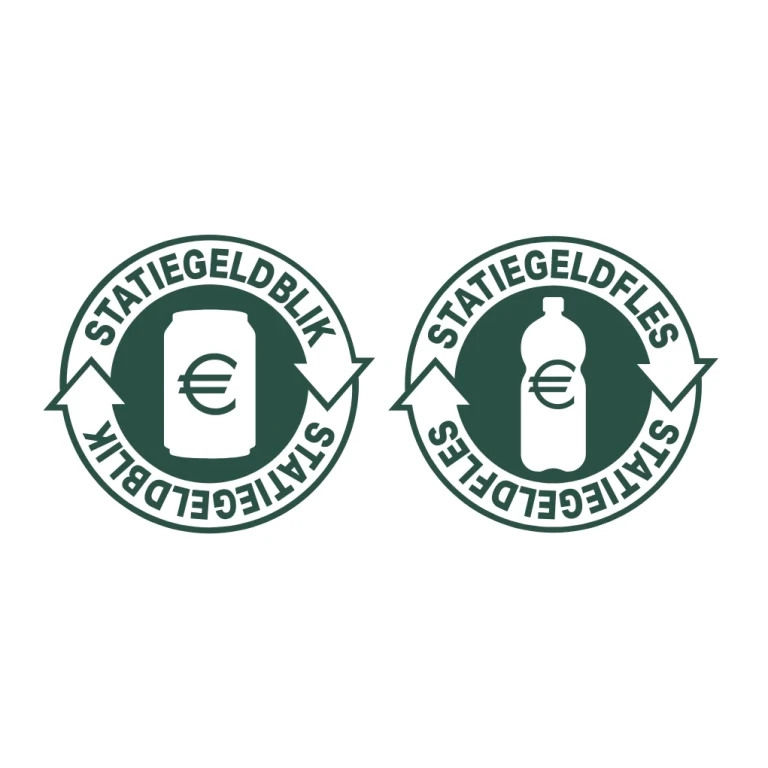
A deposit is only charged on plastic bottles and cans that have the deposit logo on them. It looks like this:
How does it work?
People are less likely to throw away packaging if they get money back for it. That is the idea behind the deposit system. Do you buy a bottle or can at the supermarket that has a deposit on it? And do you - or the cashier - scan the barcode? Then the register automatically adds the deposit amount to your total. Every product subject to a deposit has a deposit logo on it. The logo lets you know that there is a deposit on it. That way, you know you will have to pay extra for it.
If the bottle or can is empty, you can return it. You will get your money back.
Waar kun je lege flesjes en blikjes inleveren?
Je kunt flesjes en blikjes inleveren bij de supermarkt en soms ook bij benzinestations of op het treinstation. Meestal zijn er nog andere plekken bij jou in de buurt waar dit kan. Op deze website kun je zien waar je in jouw dorp of stad lege producten waar statiegeld op zit weer kunt inleveren.
The machine where you return the bottle scans the bottle or can. It checks the barcode and the shape of the bottle or can. This is how it recognises the container and ensures you receive the correct refund. You will receive a receipt. The receipt shows the amount you will be refunded. You can hand this receipt to the cashier, who will then give you your money back.
Is there no cash register nearby? For example, because you are returning your can or bottle at Amsterdam Centraal, Rotterdam Centraal, Den Haag Centraal, Utrecht Centraal or Eindhoven Centraal train stations? In that case, you can scan the receipt you receive and have the money deposited into your account via the Tikkie app. You will need to have the Tikkie app on your phone. If you scan the receipt with your phone’s camera, the Tikkie app will open automatically.
Companies use the returned containers to make new bottles and cans. They reuse some bottles more than once.
Why do deposit systems exist?
The main purpose of a deposit system is to reduce litter. Supermarkets and
Why do not all bottles have a deposit?
The Dutch government designed the deposit system primarily to reduce litter. Plastic bottles of laundry detergent, shampoo or cleaning products are usually used at home. As a result, they are less likely to end up as litter on the streets. And that is why there is no need for a deposit on them.
There are exceptions when it comes to beverage containers as well. And some bottles of milk or yogurt, fruit juices or syrups did not used to have a deposit, but they do now. As a result, it is sometimes unclear. One plastic bottle may have a deposit, while another does not. The government will be looking into how to make this clearer in the near future. But you can already tell whether a bottle or can has a deposit by looking at the deposit symbol on it.
Why are there not deposits on wine bottles?
People usually drink wine at home, too. That is why there are fewer wine bottles on the street. In addition, people often put their wine bottles in the glass recycling bin themselves. That is why there is no need for a deposit on bottles that can be placed in the glass recycling bin. The government also sees the glass recycling bin as a good way to reuse glass.
Why can a can not be damaged?
Many people have noticed that a machine sometimes refuses to accept a damaged can. That is because the machine needs to be able to verify that the container is actually eligible for a deposit refund. The machine must therefore be able to read the barcode and check the shape of the can. And it often cannot do that if the can is broken or dented.
Does the deposit system work?
Overall, the deposit system works well in the Netherlands. People have been returning more bottles and cans since a deposit was introduced. On average, people return 71 percent of all bottles to the store, and 75 percent of all cans. Since 2023, this has amounted to billions of bottles and cans.
But not everyone returns their bottles and cans. People still throw a lot of bottles and cans in the rubbish. Or on the streets. In some places, there are not enough locations where you can return bottles and cans. And sometimes the return machines do not work properly. The Dutch government wants people to return 90 percent of their bottles and cans. That is why there will be more return locations and clearer rules. So people know which bottles and cans they can return.
You can also give your returnable bottles and cans to other people
Since you get money for them, many people go out looking for empty bottles and cans themselves. Especially in the big cities, there are many people who could really use the deposit money. Either because they have little money of their own or because they are homeless. That is why many residents leave their empty cans or bottles on top of or next to a rubbish bin, so that other people can pick them up and return them. And use the money to buy something to eat or drink.
As a result, the deposit system also has a downside. Because people go looking for bottles and cans, they often open rubbish bags and rubbish bins. They think there might be empty bottles and cans in there. And often there are. But because they open the rubbish bags, a lot of rubbish ends up on the street again, where it gets blown away by the wind. And the whole point of the deposit system was precisely to reduce the amount of rubbish on the street.
Many municipalities are therefore looking into new rubbish bins that can solve that problem. For example, because they have an extra opening for empty bottles and cans.