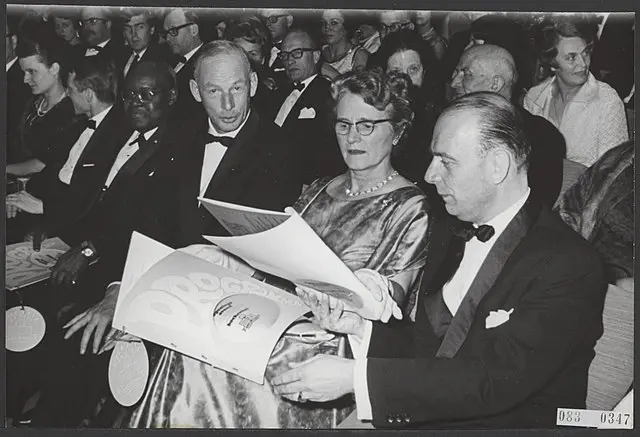
Marga Klompé: the first female minister in the Netherlands
Share on social media:
Marga Klompé (1912–1986) was the Netherlands’ first female minister. She was once tipped as a potential first female prime minister. However, she felt that the Netherlands was not yet ready for that. In this article, you can read about who she was and what she achieved.
Marga Klompé: intelligent and talented
Marga Klompé was born in Arnhem on 16 August 1912 into a Catholic family. She grew up in a family of five children. The family struggled financially, but Marga was bright and eager to learn. That is why she was still able to continue her education and go to university.
She studied chemistry at Utrecht University. She later went on to obtain a PhD in the natural sciences. She then worked as a chemistry teacher in Nijmegen.
Marga wanted to continue developing her skills. She also started studying medicine, but was unable to complete her degree.
Marga Klompé during the Second World War
During the Second World War, Marga Klompé was active in
Marga was also active in the Union of Women Volunteers. This was a Dutch organisation that provided practical help and care during the war and the post-war reconstruction. In 1943, she became its vice-chair. She held that position for around 10 years.
In 1944, there was heavy fighting in and around Arnhem. At the time, Marga helped organise medical and food aid for civilians who had been forced to flee. She also assisted with the evacuation of the city.
After the liberation of Arnhem, she worked alongside other volunteers to help get life back on track in the city.
Political role after the war
Immediately after the war, Marga Klompé became politically active. She believed it was important for more women to enter politics. That is why, together with a friend, she founded the ‘Roomsch Katholiek Vrouwendispuut’ (Roman Catholic Women’s Association). Through this group, she encouraged women to become politically active.
In 1947, on the advice of women’s organisations, she was appointed to the Dutch delegation to the
In 1948, she was elected to the House of Representatives. In 1952, she also became the first woman to represent the Netherlands at the European Coal and Steel Community. That organisation was a forerunner of the
The Netherlands’ first female minister
In 1956, Marga Klompé became the Netherlands’ first female minister. She was appointed Minister for Social Welfare in the cabinet of
First woman to serve as Minister of State
In 1967, Marga Klompé was mentioned as a possible prime minister when a new government was to be formed. She did not want to take on the role. She felt that the Netherlands was not yet ready for a female prime minister at that time.
In 1971, Klompé became the first woman to be appointed ‘Minister of State’. This is an honorary title bestowed by the King upon politicians who have made a significant contribution to the governance of the Netherlands. Following this appointment, she retired from politics.
After that, she devoted herself primarily to the Roman Catholic Church and to the causes of peace and justice. Even when she fell seriously ill in the 1980s, she remained active for as long as possible. Marga Klompé died in 1986.
For these reasons, Marga Klompé was significant
Marga Klompé is significant because she opened up more opportunities for women in Dutch politics. As the first female minister, she demonstrated that women are also capable of making important decisions. She helped build the welfare state and ensured that social security became more of a right than merely a form of assistance. Her work made the Netherlands a more socially inclusive society. She also became a role model for many women. She took responsibility and remained committed to a fairer society.