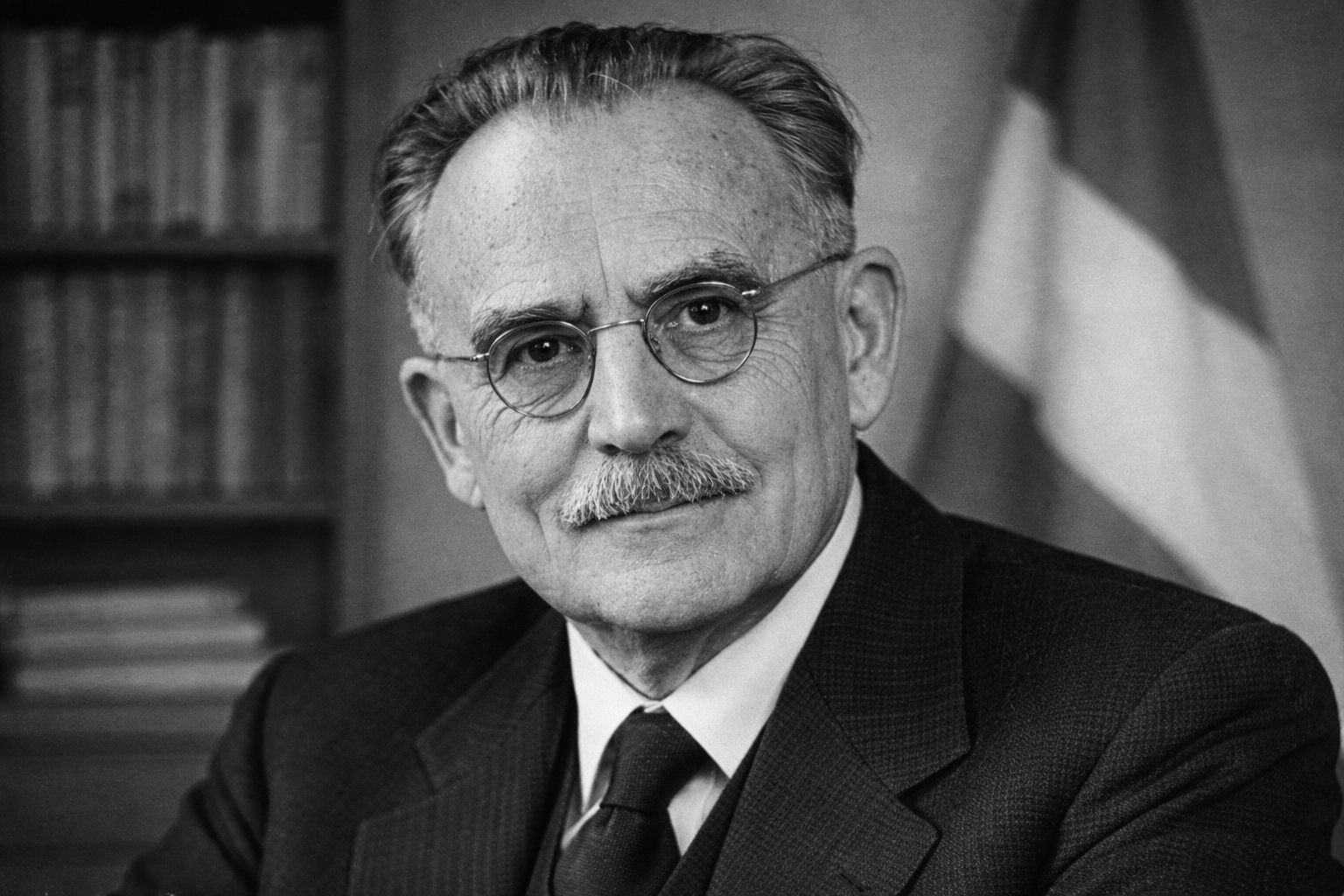
Willem Drees: the prime minister who built the Netherlands after the war
Share on social media:
Willem Drees is seen as the person who rebuilt the Netherlands after World War II. He was prime minister for 10 years and was known as a calm and reliable leader. Many people called him Father Drees. In this article you can read more about Willem Drees and why he was so important.
Willem Drees' portfolio
Willem Drees (1886-1988) was a well-known Dutch politician of the Dutch Labour Party (PvdA). He served as prime minister from 1948 to 1958.
Drees grew up in Amsterdam. He started with a job in office and then went into politics. He became a
During World War II, the Germans held Drees prisoner. After his release, Drees played an important role in the political resistance.
After the war, Drees helped run the country again. In 1945, the queen of the Netherlands asked him to help form a new government to rebuild the Netherlands after the war.
Drees as prime minister
Willem Drees was prime minister of the Netherlands from 7 August 1948 to 22 December 1958. During that time, he led four
After World War II, the Netherlands had many problems. The Netherlands experienced major economic problems and there was a serious housing shortage. Drees worked to rebuild the country. During these years, social security also grew, such as help for people with low incomes.
One of the most difficult subjects of his time was the Dutch East Indies (Indonesia). The Netherlands had to decide to let go of the colony. This was a difficult and important period in Dutch history.
Why was his name Father Drees?
Willem Drees was nicknamed Father Drees because many people saw him as a caring and reliable leader. After World War II, there was a lot of poverty, especially among older people without pensions. Drees wanted the elderly not to run out of money.
As Minister of Social Affairs, he created the Dutch Emergency Old Age Pensions Act ('Noodwet Drees') in 1947. This law gave a
Later came the
Drees was also called fatherly because of his sobriety and quiet manner of leadership. He was popular even with people who did not vote for his party.
Minister of State
After leaving the role of Prime Minister on 22 December 1958, Willem Drees was awarded the honorary title of 'Minister van Staat' (minister of state). This is a special title bestowed upon politicians who have made a significant contribution to the Netherlands. He remained involved with the PvdA party and politics for many years afterwards. In 1971, he left the party because he was no longer happy with the PvdA. Willem Drees died on 14 May 1988, aged 101.
Drees is also known for saying, "Niet alles kan, en zeker niet alles tegelij" (not everything can be done, and certainly not everything at once). People use this phrase to say you have to make choices.
Willem Drees was so important for these reasons
For many people, Willem Drees became a symbol of the build-up of the Dutch