Rembrandt van Rijn: painter of light, shadow and emotion
Share on social media:
Rembrandt van Rijn (1606–1669) was a Dutch artist. He produced many paintings, drawings and etchings. His works of art are now very famous. Some of Rembrandt’s paintings are also worth a great deal of money. In this article, you can read more about Rembrandt van Rijn and his work.
Born and raised in Leiden
Rembrandt van Rijn was born in Leiden. In 1620, his parents enrolled him at Leiden University. Rembrandt was four years old at the time. He studied the classics there – a subject now known as languages and literature. He probably also received tuition in religion and biblical stories. Rembrandt often painted scenes from the Bible, mythology and history. However, Rembrandt did not continue his studies at the university. He wanted to become a painter.
Rembrandt learns to paint
Around 1622, Rembrandt became a pupil of the Leiden painter Jacob van Swanenburgh. This painter produced cityscapes and scenes from hell. Rembrandt later moved to Amsterdam, where he was taught by Pieter Lastman. Lastman was a well-known painter of historical and biblical scenes.
After about half a year with Lastman, Rembrandt set up his own workshop in Leiden.
Rembrandt’s portraits
Rembrandt painted many self-portraits. In his self-portraits, Rembrandt revealed not only his face, but also his feelings. Sometimes he depicted himself as an important figure from the Bible or history.
People from his own life also frequently featured in his work. For example, his wife Saskia, his son Titus and his friend Hendrickje Stoffels. They sometimes served as models for biblical, mythological or historical figures.
Rembrandt’s techniques
Rembrandt had a distinctive style of painting. He worked freely and with great sensitivity. Many painters would first create a clear drawing on the canvas. Rembrandt often began more quickly and loosely with paint. He sometimes used thick layers of paint. This is called ‘impasto’ in Italian. The thick paint gave the painting more texture. You can almost see the movement of the brush.
Sometimes he applied thin, transparent layers of paint over a light undercoat. This created deep colours. He also used a dry brush. This means the paint does not remain equally thick everywhere. As a result, the painting takes on a lively and sometimes grainy texture.
Rembrandt also made powerful use of light and shadow. This gave his paintings a great deal of depth and drama. Thanks to these techniques, the people in his paintings appear lifelike and full of emotion.
Rembrandt also produced etchings
Rembrandt was not only a painter, but also an etcher. An etching is an image created by an artist on a metal plate. The image can then be printed onto paper.
Rembrandt produced nearly 300 prints. He was constantly experimenting with new techniques. For example, he worked with different types of paper and with light and dark.
His etchings also became well known outside the Netherlands. This was because it was possible to make multiple prints from a single metal plate. As a result, his prints could be distributed more easily throughout Europe than his paintings.
Rembrandt’s own style
Rembrandt became famous for his unique style of painting. He made extensive use of light and dark. This gave his paintings a great sense of depth and emotion. He often painted people very naturally: he did not make them look more beautiful than they were. He also skilfully conveyed what people were feeling, such as sadness, fear, pride or doubt.
Prominent figures from Leiden bought his art. Rembrandt continued to develop as an artist. He learnt from other artists, but also increasingly made his own choices.
Rembrandt in Amsterdam: success and love
In 1631, Rembrandt began to work in Amsterdam more and more. He received many commissions there. He mainly painted portraits of wealthy and influential people. At that time, Amsterdam was a wealthy trading city. Many people wanted to have their portrait painted.
His wife, Saskia, often features in his paintings
In 1634, Rembrandt became a member of the Amsterdam painters’ guild. In the same year, he married Saskia Uylenburgh. Saskia played an important role in his life. Rembrandt often drew and painted her. He sometimes painted her as himself, but also as a character from a story. For example, as Flora, the Roman goddess of spring. This allowed Rembrandt to practise his skills with light, clothing, jewellery and emotions.
Rembrandt painted Saskia not only because she was close to him, but also out of love and to capture important moments in their lives. Rembrandt and Saskia suffered great loss in their family. Three children died shortly after birth. In 1641, they had a son who survived. His name was Titus.
In 1639, Rembrandt bought a large house in Amsterdam. The house was situated in a street where many artists lived. This house is now the Rembrandt House Museum on Jodenbreestraat. There, you can see how Rembrandt lived and worked.
The Night Watch
In 1642, Rembrandt completed one of his most famous paintings: The Night Watch. The actual title of the painting is "Officers and other members of the Second District Militia in Amsterdam, led by Captain Frans Banninck Cocq and Lieutenant Willem van Ruytenburch", but almost everyone knows the work as The Night Watch. The painting depicts members of an Amsterdam militia company. This was a group of men who helped to protect the city.
The Night Watch is significant because Rembrandt did something new. Group portraits at that time were often calm and orderly. People usually stood or sat still next to one another. Rembrandt, on the other hand, turned it into a lively painting. The figures are moving, looking in different directions and appear to be in the midst of the action. As a result, the painting almost resembles a scene from a story. That is why The Night Watch later became a symbol of the Dutch
Famous after his death
Rembrandt died on 4 October 1669 in Amsterdam. He was 63 years old at the time.
In the final years of his life, Rembrandt did not always have it easy. He had financial difficulties and lost people he loved. Yet he continued to paint, draw and etch. After his death, Rembrandt became increasingly famous. He is now regarded as one of the most important painters in Dutch history.
His paintings are on display in museums all over the world. In the Netherlands, you can view some of his major works at the Rijksmuseum in Amsterdam, the Mauritshuis in The Hague and Museum De Lakenhal in Leiden.
There are also many paintings by Rembrandt outside the Netherlands. For example, in major museums in London, Berlin, Paris, St Petersburg, New York, Washington and Vienna.
Rembrandt in monuments, statues and street names
Rembrandt is not only famous for his paintings. In various cities, you can also see reminders of him on the streets.
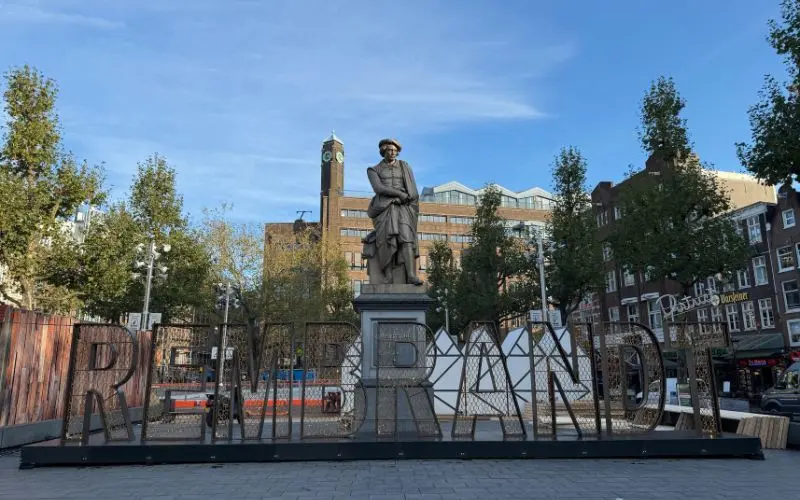
The best-known example is the statue of Rembrandt on Rembrandtplein in Amsterdam. This statue was unveiled in 1852. The square was later officially named Rembrandtplein.
Rembrandt’s presence can still be felt in Leiden, the city where he was born. At the site where his birthplace once stood, you will find a statue and a commemorative plaque.
His name also often features in street names. In many towns and cities across the Netherlands, there are streets and avenues with names such as Rembrandtstraat, Rembrandtlaan or Rembrandtplein.
In this way, Rembrandt remains a visible presence in everyday life. Not only in museums, but also in squares, on the streets and in public spaces.