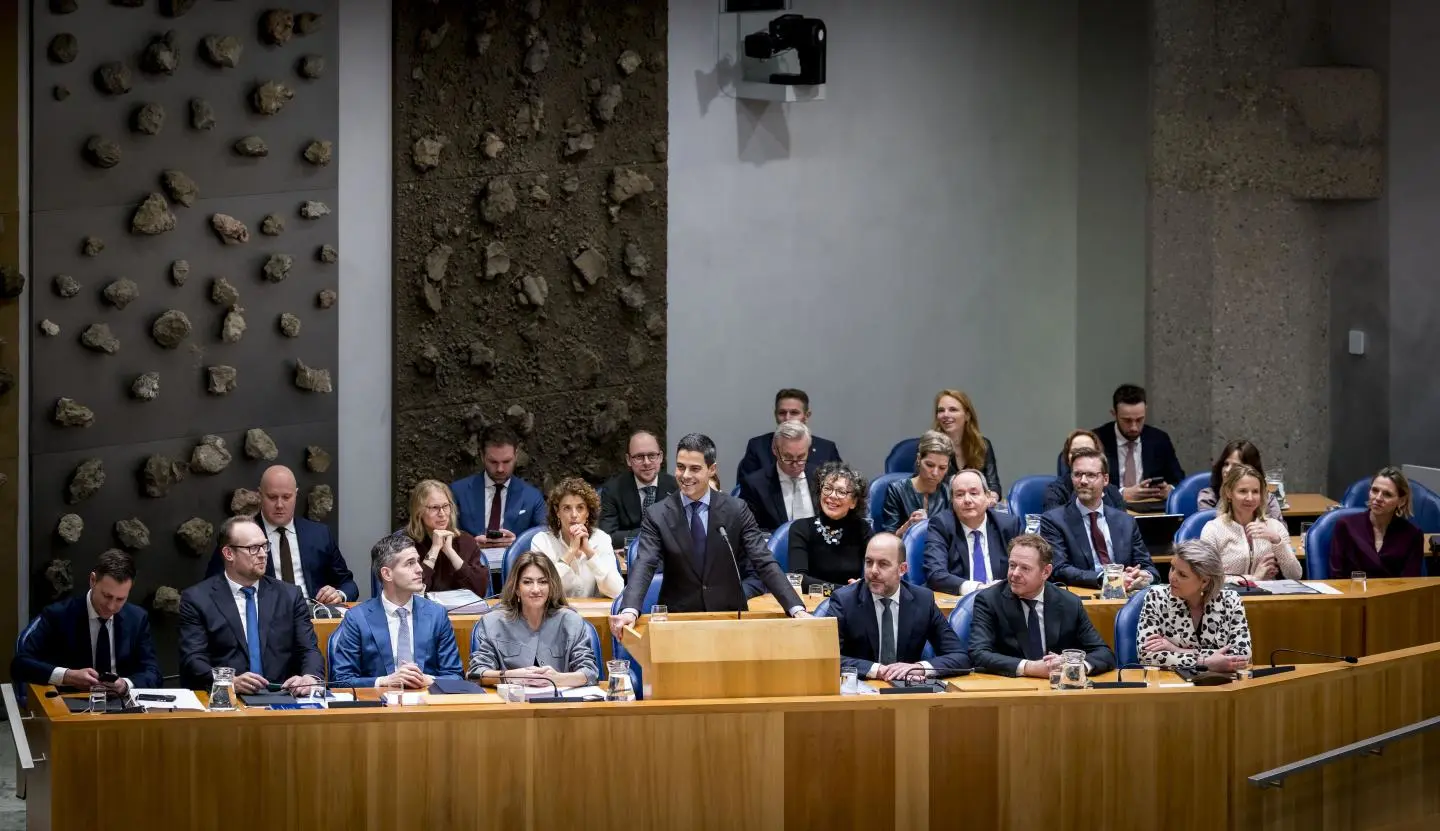
Jetten cabinet launched: what plans are there for refugees?
Share on social media:
The new cabinet of D66, VVD and CDA was sworn in on 23 February 2026. The coalition agreement contains plans on asylum, reception centres and integration. In this article you can read what the agreement says about the Dutch Dispersal Act, the asylum procedure, reception locations and family reunification.
New cabinet sworn in
The cabinet made up of D66, VVD and CDA was sworn in and officially started on 23 February 2026. Swearing in a cabinet is the moment when the new ministers and state secretaries officially take up their positions, after promising the King that they will abide by the law and do their work well.
This is a minority cabinet. This means that the
The important ministers and positions are as follows:
Rob Jetten (D66): prime minister (General Affairs).
Dilan Yeşilgöz (VVD): minister of defence, and first deputy prime minister.
Bart van den Brink (CDA): minister of asylum and migration, and second deputy prime minister.
Tom Berendsen (CDA): foreign minister.
Sjoerd Sjoerdsma (D66): minister of foreign trade and development cooperation.
David van Weel (VVD): minister of justice and security.
Eelco Heinen (VVD): minister of finance.
As the cabinet needs support from other parties, plans may change during debates and negotiations in the House of Representatives and the Senate.
Previously, the coalition parties wrote a
What does the agreement say about asylum and reception centres?
Plans for the European Union: asylum, return and procedures at the border
The Netherlands will work on a 'new migration model' in a European Union context. In doing so, the
The coalition wants to organise a European asylum summit. There, countries want to make agreements on how asylum applications are made and processed. The plan is that asylum applications will no longer be filed and processed in Europe, but outside Europe's borders.
The Netherlands supports making new EU rules on return, including the possibility of people temporarily entering
before being deported. There will be an border procedure with closed reception centres for applications that, according to the
, the Netherlands wants to contribute to 'safe and humane' reception centres. As long as the reception centres in the Netherlands are not yet in order, instead of taking in people, the Netherlands mainly wants to contribute money to the agreements in the EU pact.
The coalition wants to implement asylum laws already in parliament
The coalition agreement says: if the
Possible additional measures for family reunification in case of rapid increase in asylum applications
According to the agreement, there may be additional measures in the area of family reunification if the number of asylum applications rises sharply in a short period of time. This applies if there are many more asylum applications in a short period of time, the Netherlands cannot prepare for this and reception centres and procedures become bogged down. As an example, the agreement mentions that there could be a temporary stop on bringing family members over for people who have temporary protection. There can be an exception in very special and difficult situations.
Plans to change the asylum procedure
The agreement says the
Abolish mandatory steps such as the
, mandatory medical consultation and the . If you do not cooperate in the procedure, the IND may reject your application.
More rigorous review of repeated asylum applications.
Adjust the
to go to court to the minimum rules of the EU migration pact: usually you will have a minimum of 2 weeks (and a maximum of 1 month) to appeal. In expedited or special procedures, that time frame may be shorter (about 5-10 days). Asylum seekers who, according to the government, have little chance of obtaining a residence permit may not receive help from a lawyer until after a rejection. That assessment is an initial selection by the IND, based for example on the country of origin and previous information on similar applications. The final decision follows only after the substantive assessment.
Consultations at reception locations are offered
The coalition parties wrote down in the agreement that
Stricter approach to nuisance and criminal offenses
The agreement includes plans for asylum seekers who are a major nuisance or break the law. For example:
If someone is convicted during the asylum process, the coalition wants this to count more heavily in the IND's decision.
There will be a stricter approach for people known to the government as repeat offenders on the '
'. The coalition wants more reception locations with extra supervision and stricter rules such as the
and the . Municipalities with an application centre may receive more police deployment, such as additional officers and more frequent surveillance in the area.
The coalition also wants people in reception centres to be able to do something, such as work, language classes or day care. And where needed, they want better help with trauma or addiction.
What does the agreement say about reception centres and housing?
Fewer emergency reception centres and more permanent reception centres
The agreement says that reception centres must be "put in order". That is why the coalition wants:
Multi-year funding for the organisations that deal with asylum and reception centres such as IND and COA.
Close emergency recepeption centres and replace them with regular reception centres.
Keeping the
in place for now.
Extra protection for vulnerable groups in reception locations
The agreement mentions extra protection for vulnerable groups in reception centres, such as LGBTQIA+ individuals, children and people who have changed their religion. It also states that unaccompanied minor refugees can receive longer supervision where necessary. They can receive counselling up to age 21 instead of 18.
Status holders and social housing
The agreement states that, for the time being, municipalities will be given more leeway to make their own policy on priority for status holders in social housing, as long as there is no good alternative. The coalition also wants to make agreements with municipalities on temporary housing locations such as
Integration: participating with language, work and school
The coalition agreement also contains plans on integration. The coalition wants newcomers to be able to participate more quickly in the Netherlands, for example with language and work. Among other things, the agreement states:
Asylum seekers with a good chance of obtaining a residence permit would be allowed to work after 3 months in the asylum procedure. Asylum seekers with a poor chance of asylum would not be given that right.
The coalition wants fewer rules around working. For example: an alternative to the work permit, making work easier.
The coalition wants promising asylum seekers to begin language classes right at the beginning of the asylum process.
At larger reception locations, the coalition wants a
. There, people can get help with language lessons, volunteer work or paid work. Ukrainians are under the Temporary Protection Directive until 2027. From 2027, the coalition wants to establish a temporary residence status for them.
The coalition wants to expand pilots with entry-level jobs for refugees. These are jobs that you combine with language classes, as a stepping stone to regular work.
The coalition wants to make the rules for becoming a Dutch citizen stricter: according to the agreement, you can do so after 6 years, if you have received a temporary residence permit twice and speak Dutch at level B1. Exceptions may apply in special cases.
What does this coalition agreement mean to you now?
At the moment, nothing will change immediately. The plans from the coalition agreement must first be discussed and worked out. RefugeeHelp is following the decisions and publishing updates if anything changes that will affect your procedure, reception or rights.