Vincent van Gogh: his story, style and most famous works
Share on social media:
Vincent van Gogh (1853–1890) was a Dutch painter. Today, he is world-famous. His paintings hang in major museums and are viewed by millions of people. Yet during his lifetime, he was neither rich nor famous. It was only after his death that he received widespread recognition. In this article, you can read more about his life and his art.
Vincent van Gogh's youth
Vincent van Gogh was born in Zundert, a village in the province of North Brabant. His father was a minister. The family often went for walks in the countryside. This gave Vincent a love of trees, fields, flowers and landscapes from a young age. Nature would later become a major theme in his art.
Van Gogh finds his way
When he was sixteen, Vincent started working at an art gallery in The Hague. From that time onwards, he also began writing letters to his younger brother Theo. These letters are important because they tell us a great deal about his life, his thoughts and his art.
Vincent later lived in various cities, such as London and Paris. He initially worked in the art trade, but gradually lost interest in that line of work. He then tried his hand at other professions. He worked as a schoolteacher and also wanted to become a minister, just like his father. Yet art remained important to him. At the age of 27, he decided to become an artist.
First steps as an artist
Van Gogh was largely self-taught. He practised drawing and painting with great dedication. In The Hague, he took lessons from the artist Anton Mauve. There, he learnt to work more effectively with perspective, watercolours and oil paints. His brother Theo often helped him with money and advice.
Vincent often chose ordinary people as his subjects. He wanted to show how hard their lives were. For him, art did not just have to be beautiful. Art also had to convey emotion and truth.
Dark colours in the Netherlands
In the Netherlands, Van Gogh mainly painted labourers, miners and landscapes. In Nuenen, he produced many works depicting rural life. His colours at that time were often dark: brown, grey and dark green. A well-known painting from this period is The Potato Eaters. Through this work, he sought to portray the harsh life of farmers.
Van Gogh faced a great deal of criticism during this period. Many people felt his work was too dark and too rough. Yet he carried on regardless. He considered emotion more important than a perfectly neat painting style.
Antwerp and Japanese art
In 1885, Van Gogh moved to Antwerp. He visited museums and studied the works of the old masters closely. He also enrolled at the art academy. But his style was too free and too powerful for the academy’s strict rules.
In Antwerp, Van Gogh also discovered Japanese prints. He hung them on the walls of his room. The bright colours, bold lines and unusual compositions made a great impression on him. This influence was later clearly evident in his paintings.
From dark to light in Paris
In 1886, Van Gogh set off for Paris. At that time, Paris was a major centre for modern art. There, Vincent saw the work of artists such as Claude Monet and other modern painters. As a result, his style changed significantly. His paintings became lighter, more colourful and freer.
He started to work with short brushstrokes and strong colour contrasts. Japanese art also remained important to him. His work shifted from being dark and heavy to bright and lively.
The Yellow House in Arles. A significant period in his career
After two years, the hustle and bustle of life in Paris became too much for Van Gogh. That is why, in 1888, he travelled to Arles, in the south of France. He hoped to find peace, light and inspiration there. He wanted not only to paint there, but also to host other artists. His dream was of a house where artists could live and work together.
The sun, the blue sky and the bright colours of the South of France made a deep impression on him. In a short space of time, Van Gogh produced many paintings. He painted landscapes, bridges, boats, flowers and portraits. Many of his best-known works were created during this period, such as Sunflowers, Bedroom in Arles and The Yellow House.
Although Vincent had hoped that more Parisian artists would come to Arles, in the end only Paul Gauguin came to live and work with him. And that collaboration was short-lived. They soon fell out. Just before Christmas 1888, they had a major row. After that, Van Gogh became distraught. During one of his anxiety or panic attacks, he cut off part of his left ear. He was then taken to hospital.
No one knows exactly why he cut off his ear. There are many theories about his illness, but no clear diagnosis has been made. What is certain, however, is that Van Gogh continued to paint tirelessly, even during difficult periods.
Van Gogh’s style and self-portraits
Van Gogh’s style changed significantly during his lifetime. At first, his paintings were dark and sombre. Later, his work became lighter and more colourful. In Paris, he learnt to work with short brushstrokes and bright colours. In Arles, he used bold colour contrasts, strong lines and plenty of yellow, blue and green. He used colour not only to depict reality, but also to express emotion. That is why his paintings are so recognisable.
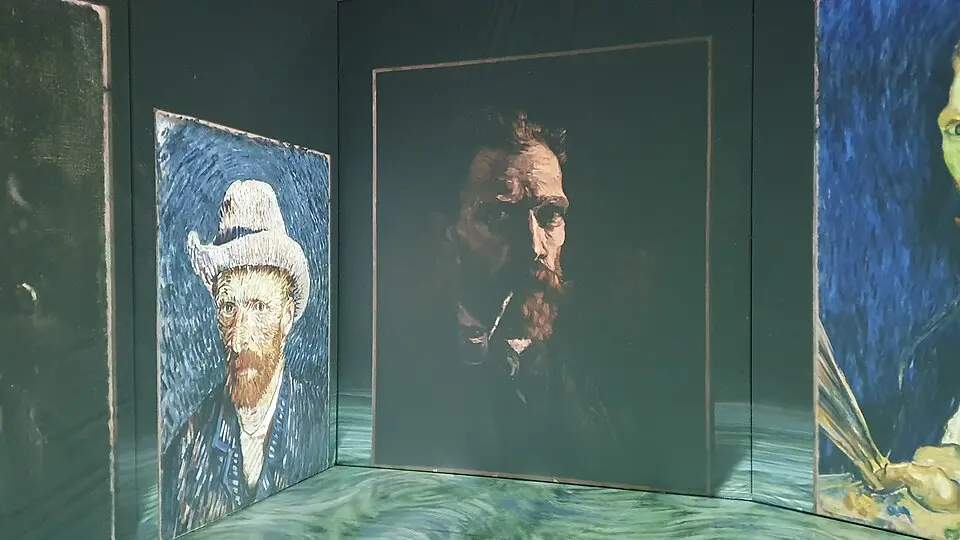
His self-portraits clearly show how his style developed over the years. He experimented with colour, light, brushstrokes and facial expressions. Sometimes he painted himself looking calm, and at other times tense or serious. In this way, he used his own face to try out new ways of painting.
Van Gogh also produced many self-portraits. No fewer than 39 of his self-portraits have survived, including both paintings and drawings. He produced most of these in Paris. A self-portrait was inexpensive, as he did not have to pay a model.
His moods, illness and death
In 1889, Van Gogh checked himself into a sanatorium in Saint-Rémy, France. His mood and health fluctuated greatly. Yet he remained highly productive there too. In the space of about a year, he produced around 150 paintings. He was also given an extra room which he could use as a studio.
In Saint-Rémy, he painted irises, olive trees, cypresses and The Starry Night, among other works. Painting gave him a sense of stability during a difficult period.
In May 1890, Van Gogh moved to Auvers-sur-Oise, near Paris. There, he lived closer to Theo. Yet even there, he once again felt gloomy and uncertain. On 27 July 1890, he shot himself in the chest. He died two days later, with Theo by his side. He was 37 years old.
Only became famous after his death
Van Gogh’s life was turbulent. He worked hard, moved house frequently, did not always eat properly and sometimes felt ill and exhausted. He also often lived in poverty. He regularly fell out with those around him. His relationship with his brother Theo wasn’t always easy either. Yet Theo remained the most important person in his life. The brothers continued to write to and support one another.
And however badly things sometimes went for Vincent, he continued to paint and draw. In total, Van Gogh produced nearly 900 paintings and more than 1,100 works on paper. But during his lifetime, he received little recognition. It was only after his death that his work became increasingly well known. This was largely thanks to Jo van Gogh-Bonger, the wife of his brother Theo. She sold some of his works, loaned other paintings for exhibitions and published the letters of Vincent and Theo. As a result, more and more people came to know Van Gogh and his art.
Today, Vincent van Gogh is famous across the globe. Among his best-known works are Sunflowers, The Starry Night, Bedroom in Arles, The Potato Eaters and Café Terrace at Night. His paintings are worth a great deal of money. In 2017, his ‘Laboureur dans un champ’ was sold for over 81 million dollars. Van Gogh is so famous because his work is powerful, colourful and personal. He painted not only what he saw, but also what he felt. It is precisely for this reason that his paintings still touch so many people. People from all over the world come to see his art. The Van Gogh Museum in Amsterdam welcomed more than 1.8 million visitors in 2024.
You can see Van Gogh’s art for yourself
Would you like to understand Van Gogh better? Then why not see his work for yourself? At the Van Gogh Museum in Amsterdam, you can see how his style evolved over time: from dark paintings to vibrant works full of colour and emotion.
The Kröller-Müller Museum in Otterlo is also a great place to get to know van Gogh better and admire his work.
A visit to both museums brings his story full circle. Not only do you see his paintings, but you also get a better sense of just how extraordinary his life and art were.