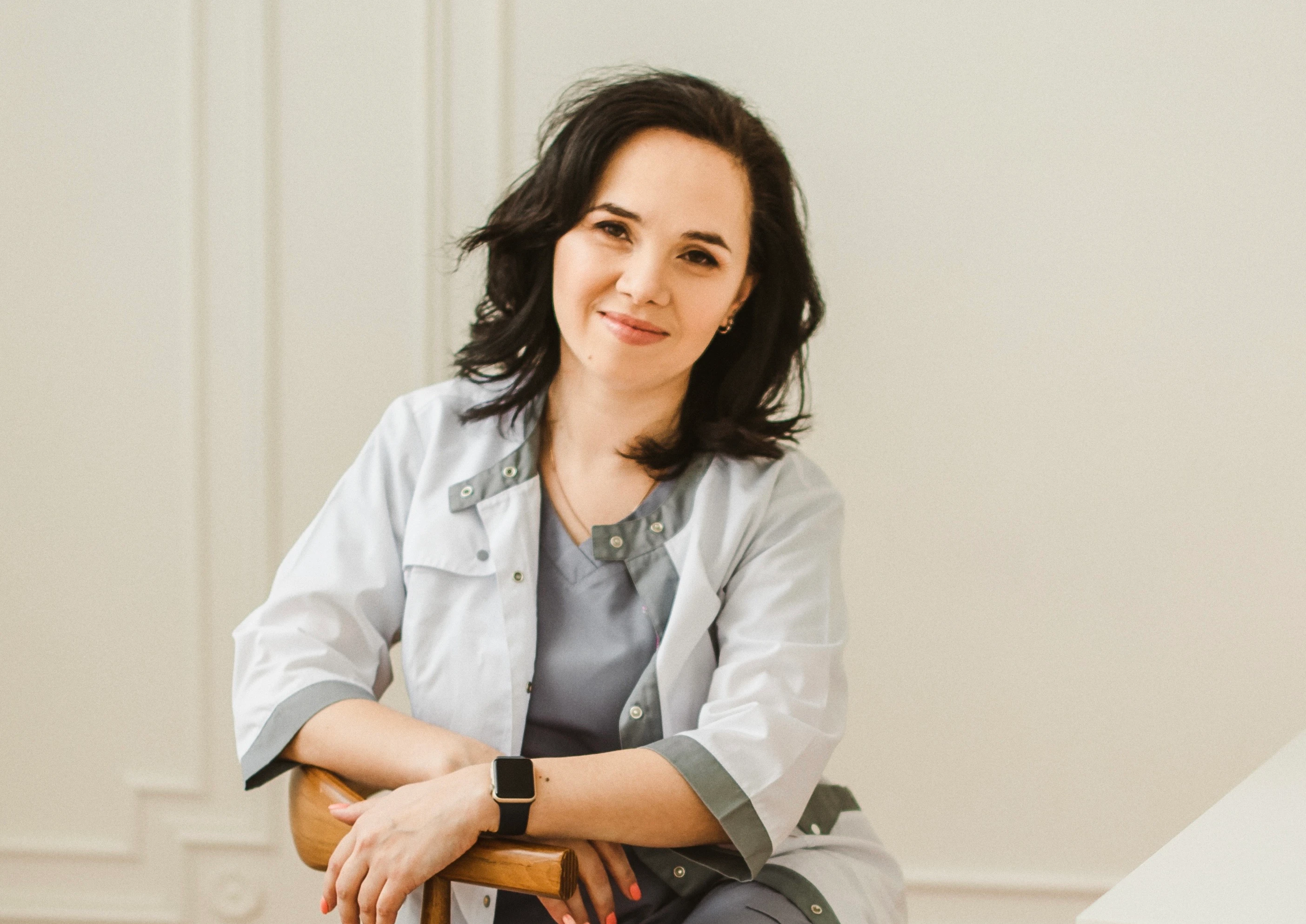
Mariia from Kharkiv found a job in the Dutch healthcare sector: ‘Get to know Dutch people and let them know what you can do’
Share on social media:
For many Ukrainians in the Netherlands, it is difficult to find work that suits them. Yet sometimes they do manage it. Take, for example, Dr Mariia Oliink (47) from Kharkiv. ‘In the end, there is always someone willing to help you.’
Back in Kharkiv for a while
During the interview, Mariia is still in Kharkiv, where she attended her son’s wedding the day before. Speaking in fluent Dutch, she describes how exciting it is to be back in the city where she used to live and work before the war. And how lovely it is to see her family and friends again.
Mariia began her career in 2003 as a GP, but later specialised in rheumatology. From 2016, she worked as a lecturer in internal medicine and as a rheumatologist at the hospital in Kharkiv. Her son was studying at the university there and her daughter was in her final year of secondary school when the war began.
Mariia: “I was woken at 5 o’clock in the morning by the bombs falling on our city. When I looked outside, I saw buildings on fire.” Mariia still remembers the panic of those first few days very well. “Fortunately, we were able to take shelter in the garage beneath our flat, but the fear did not go away. Out of concern for my children’s safety, I decided to leave Kharkiv.”
They set off for Lviv, where they rented a flat for a few months. But the fear was there too. Her daughter wanted to leave Ukraine. She wanted to join friends who had found a safe place in the Netherlands. Her son wanted to stay with his friends in Lviv. Mariia therefore decided to leave for the Netherlands with her daughter.
To the Netherlands from Kharkiv
“I had actually been to Amsterdam once before, in 2016, for a conference. At the time, my family and I visited the Rijksmuseum, the Rembrandt House, the canals and the tulip fields. That was all I saw of the Netherlands back then,” says Mariia. “And now I was going to live there.”
They ended up staying with a host family in Beneden-Leeuwen, a small village in the Betuwe. They were given a room with an en-suite bathroom by a friendly host family. “That first year, I was mainly focused on my daughter’s health,” says Mariia. “Every month, I thought about our return to Ukraine. Fortunately, I was able to continue teaching my students in Kharkiv online, but I missed my work as a rheumatologist very much.”
Her daughter was awarded a scholarship from
Doubts about the future
Whilst her daughter was settling in, Mariia remained uncertain. “Our stay here was meant to be temporary,” says Mariia.
She struggles not only with pronouncing the word “temporary”, but also with the role that the word has come to play in her life. Because “temporary” has now lasted four years. “My Ukrainian medical degree was not recognised in the Netherlands. And to be able to work as a doctor here, I first had to learn Dutch,” says Mariia. “But was there any point in investing in that if I might end up returning to Kharkiv anyway? And what if the Netherlands decided to end the temporary protection? Would we then have to go back to a country at war?”
But her daughter really wanted to stay in the Netherlands. That is why they stayed.
Looking for a job that suits her
"I then decided to start looking for work in earnest. I could not work here as a doctor because my qualification had not been approved yet. But I speak English, I have research experience, I can teach and I have good computer skills," says Mariia. "I thought, 'Surely there must be a job for me somewhere'."
Mariia: “It was harder than I had expected. I wrote dozens of letters and emails to hospitals, clinics and research institutes, asking if I could work there as a researcher. I was often turned down because I did not speak Dutch.” But she persevered and was able to take up a temporary position as a researcher at the Sint Maartenskliniek in Nijmegen.
Learning Dutch is the most important thing for Ukrainians
“With the money I earned at the Sint Maartenskliniek, I paid for the Dutch language course at the Babel Institute at Utrecht University. When I subsequently worked as a volunteer at the University Medical Centre in Utrecht, I received a 15 per cent discount on that language course,” says Mariia. “I was the only one who paid for this expensive course out of my own pocket. The other participants had the course fees reimbursed by their employers.”
Mariia: "The Dutch language is very important if you want to work in the Netherlands. In many technical professions, you can get quite far with English. But if you really want to connect with Dutch people and build a network to find work, then speaking Dutch is essential."
In January 2026, she obtained her Dutch diploma. “Then I was finally able to have my medical degree assessed for my
Networking is very important
Finding work in the Netherlands is difficult for many Ukrainians. Mariia found this to be the case too. Even with her experience and qualifications, she was unable to find a suitable job. She believes it is important to share her experiences.
Mariia: “What’s really important in the Netherlands is that you network. Make sure you build contacts with Dutch people and let them know what you are capable of and what you are looking for. For months on end, at every birthday party, every visit and every meeting, I told people I was looking for work in the medical sector. In the end, there is always someone willing to help you. In my case, it was a doctor I was friends with. He asked a colleague with a large network to post a message about me on LinkedIn. From that moment on, people started noticing me and I gained more and more contacts."
She found a job in the healthcare sector through a post on LinkedIn
Thanks to a post on LinkedIn, Mariia found her job as a health coordinator with the municipality of Arnhem in 2025. She does not work there as a doctor, but she does answer patients’ medical queries. She also works there as an interpreter. “A wonderful job,” says Mariia.
Mariia’s dream of being able to work as a doctor again – or even as a rheumatologist – never faded. She gave an
"I still cannot believe it,” says a delighted Mariia. "On 1 September 2026, I will be starting in the Rheumatology Department, where I will be working under supervision.” As she has not yet taken her final exam, she will be working under the supervision of her colleagues for the first year. “I am grateful to Zuyderland and my new colleagues for going to such lengths to make this possible.”
Mariia's tips
Mariia knows from her own experience that building a new life is not always easy. Her main piece of advice is: learn Dutch. “Especially if you are planning to stay in the Netherlands for a while, a good language course is important. The language will help you find work and feel at home more quickly.”
She also recommends doing voluntary work. That way, you practise the language, get to know new people and build up a network.
Finally, Mariia has one more simple but important tip: “Let people know you are looking for work. Talk to others and make connections. You never know who might be able to help you!”